india
Why newfound warmth between Meiteis and Nagas may not advance cause of Manipur peace
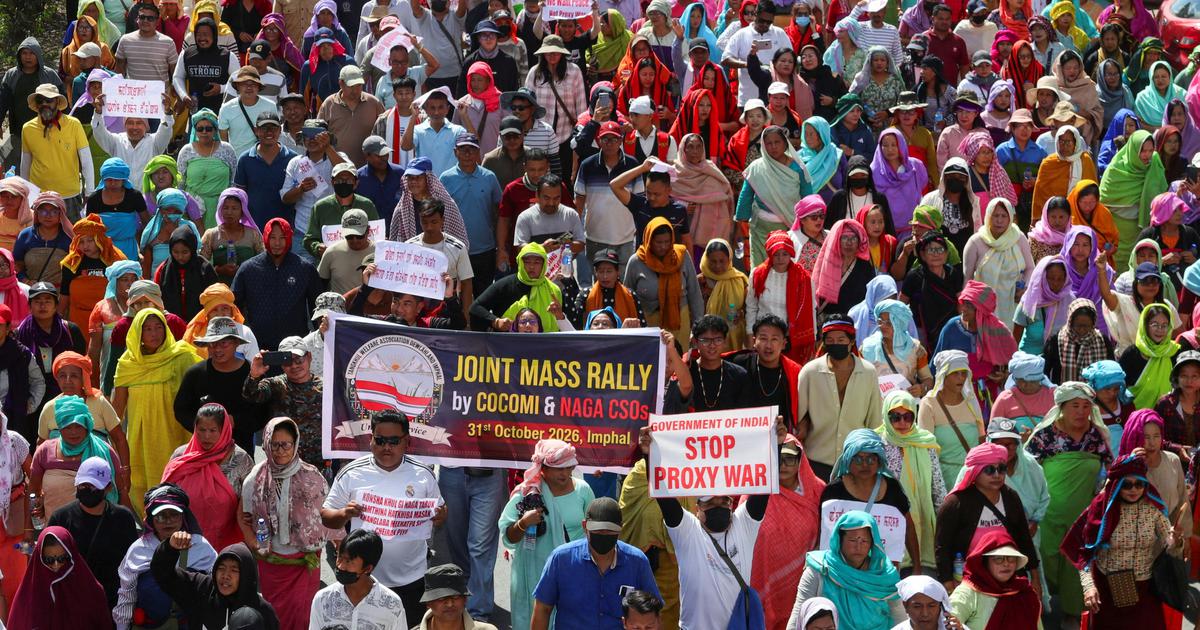
Last month, the Manipur capital saw a rare rally.
Two organisations representing the Meiteis, the majority community in the state, and Nagas, a minority tribal group, marched together on October 31 to demand that the Narendra Modi government scrap a contentious ceasefire agreement with Kuki militant groups.
Since 2023, both communities have been involved in separate ethnic conflicts with Kukis, the other tribal group in Manipur.
The United Naga Council said it was joining the rally called by the Coordinating Committee on Manipur Integrity or Cocomi because of the “terror and the existential threat to the indigenous people” of Manipur. The council also held smaller solidarity rallies in all Naga districts in the state.
Historically, both Meiteis and Nagas have had sharp differences over each other’s political demands and over the Naga demand for a separate ethnic homeland.
“With this endorsement, it doesn't mean that all other issues between us have been resolved,” said Ng Lorho, who heads the United Naga Council. “But this time we [came together] because we share interests and an agenda.”
Seilen Haokip, spokesperson of the Kuki National Organisation, called the situation a “nightmare scenario” for the Kukis and said the two groups were “ganging up” against them. The KNO is one of the signatories to the ceasefire pact that the Meiteis and Nagas want scrapped.
Experts and community leaders Scroll spoke to said this realignment could only sharpen the divisions in the state, while allowing the Bharatiya Janata Party governments at the Centre and the state to allow the situation to drift. “It is not good for the overall communal harmony in Manipur,” former Union home secretary G K Pillai said. “It will only escalate the violence.”
A contentious ceasefire
Deadly ethnic clashes between Meiteis and Kukis broke out in May 2023, setting off a spiral of violence from which Manipur is yet to recover. At least 300 people died in the conflict and thousands had to leave their homes.
It resulted in an ethnic partition of the state, with Kukis barred from entering the Imphal Valley, and Meiteis unable to access the hill districts.
While the conflict between the two groups has simmered down, thousands still remain in relief camps.
Nagas, who account for about 20% of Manipur’s total population, remained neutral through the conflict. The Kukis are the third-largest demographic group in Manipur.
But in February this year, another conflict erupted in the state – between the Nagas and the Kukis.
The two tribes live close to each other in the hills and have a history of conflict. The clashes between Nagas and Kukis that began in 1993 dragged on for five years. Hundreds were killed and several villages burned down.
Since February, at least 66 people have been killed in the Naga-Kuki conflict, with civilians turning into easy targets as armed groups from both communities fight for control.
Underlying the dispute is Naga opposition to the Kuki demand for a “separate administration” that would span most of the hill districts, and delink them from the Imphal Valley.
This is also fiercely opposed by the Meiteis, who say that the “territorial integrity” of the state cannot be compromised. Both Nagas and Meiteis dispute Kuki claims to territory, accusing them of being “outsiders” and “illegal immigrants”.
The October rally signals their coming together on a crucial demand – the abrogation of the suspension of operations agreement.
The SoO pact is a ceasefire agreement of sorts that the Centre and the state of Manipur signed in 2008 with two collectives of tribal armed groups in the hills, the United Peoples’ Front and the Kuki National Organisation. It has been periodically extended since then. However, it is yet to be renewed since it lapsed in September.
“The SoO is basically part of efforts to reduce the level of violence in the state,” former Union home secretary Pillai told Scroll. “People surrendered and agreed to keep their arms in the armory. That was helpful for peace.”
The pact has been contentious yet kept hostilities at bay to a large extent in the multicultural hills of Manipur. But Naga and Meitei groups allege that the Kuki armed groups have violated the pact by repeatedly taking part in violence against other communities since 2023.
The trigger for the renewed demand for the abrogation of the pact was the killing of three Meitei men on October 19 by suspected Kuki militants in Imphal East district. Nagas, too, have accused SoO groups of carrying out attacks on their villages.
Jeetendra Ningomba, former coordinator of Cocomi, said Meiteis and Nagas – who he called the only “indigenous” people of the state – have long been united in their demand for abrogating the SoO pact and carrying out a citizenship determination exercise in the state to weed out illegal immigrants from the Kuki community.
He also claimed that the Nagas have “changed their minds” on the demand for a greater Nagalim, spanning several states in the North East, which was at the heart of the insurgent movement led by the Nationalist Socialist Council of Nagaland (Isak-Muivah) or NSCN-IM for several decades.
“Some 10 years back, we had some different ideas because some Nagas under the NSCN-IM wanted to join Nagaland,” Ningomba said. “Now actually, they have changed their minds because they identify as Manipur people.”
Lorho, the UNC president, however, denied such a claim. The demand for a greater Naga homeland that would include areas of Manipur, Assam, Arunachal Pradesh and Myanmar across the border, he said, remains the major sticking point for any alliance between the groups.
The differences do not end there. In a recent memorandum sent to Prime Minister Narendra Modi, the Tangkhul Naga community, the largest Naga group in Manipur, cited the “disparity” between the tribal hills – inhabited by the Nagas and Kukis – and the largely non-tribal Imphal Valley, the state’s power centre, and home to Meiteis, as the primary reason for the violence and crisis in Manipur.
“Without a doubt, the sole root cause for Manipur remaining in perpetual turmoil and communal conflict is the highly skewed structure of political power sharing in absolute favour of the valley,” the memorandum, seen by Scroll, read.
Ningomba, however, said it was possible for the two groups to negotiate the terms of their cooperation. “We don’t oppose them,” he said. “If Nagas want something, we will sit at the table and negotiate. But Meitei people want to live together. We want the integrity and the unity of Manipur to remain.”
Political demands
Several Kuki leaders see the new warmth between Meiteis and Nagas with concern, and said it was a way to stop the Centre from conceding the Kuki demand for a separate administration.
“They are ganging up on us now as they see the viability of our political demand, and the possibility that it will most likely be addressed sooner rather than later,” Haokip of the KNO said.
The Kuki groups have been negotiating a separate administrative unit for themselves with the Narendra Modi government since the 2023 violence.
Haokip contrasted the Kukis’ “constitutional demand” with the Naga demand for independence and sovereignty, which the Indian state is yet to concede. “They see the potential of our issues being resolved politically, while theirs asking for independence is a big question mark,” he said.
In 2015, Prime Minister Narendra Modi’s government signed a landmark “framework agreement” with the NSCN (IM), raising hopes of a resolution to India’s oldest insurgency. But since then, the talks have hit a deadlock, especially over questions of a separate flag and constitution for Nagas.
Naga leaders admit that the peace talks cast a shadow over their conflict with the Kukis. “As long as the Naga peace talk is pending, the problem will be there,” Lorho said.
Moreover, the new Naga position is not without its detractors from within the community.
A prominent Naga leader, who is also the former chairman of United Naga Council, warned against ignoring the historical grievances that unite both tribal groups of Manipur.
“The tribals of Manipur, Nagas and Kukis, are less protected constitutionally as compared to other tribes of Northeast,” he said. “But the Meiteis oppose the Sixth Schedule, which gives tribal areas rights over land and jobs. They oppose the Naga ceasefire. They oppose the designated camps of [armed cadres]. They refuse to give more autonomy to the existing district councils. They want everything in the valley.”
The 10 tribal hill districts of Manipur enjoy special protections under Article 371C of the Constitution. However, both Nagas and Kukis have been demanding more autonomy and powers to the councils citing an imbalance in “development” between the areas of the hills and valley of Manipur over the years.
The Naga leader criticised the UNC for surrendering its political agenda and falling prey to “divisive politics”. “This will only help the Meiteis against the tribals,” he said.
Other leaders called the decision to support the Meiteis a “temporary” alignment, confined to a single demand to scrap the SoO pact.
“In the past, Meiteis used the Kukis to fight against the Nagas,” Chuba Ozukum, convenor of Global Naga Forum, said. “After the 2023 conflict, Meiteis also changed their strategies. Now Nagas and Meiteis, having the same agenda, are working together on that. In future again, this might change, when the issue of the integration of the Naga homeland is resolved.”
Imphal, Manipur: Thousands of people from different communities participate in a mass rally organised by COCOMI and various civil society organisations, demanding an end to the alleged “proxy war”, abrogation of the Suspension of Operations (SoO) agreement with Kuki militant… pic.twitter.com/UbdyB6Jx3H
— IANS (@ians_india) October 31, 2026
An intractable conflict
The political battle over the ceasefire, experts say, does not address the root of the violence.
G K Pillai, the former Union home secretary, told Scroll that the abrogation of the SoO will not bring down violence in the state, until the civilian population gives up arms.
“If you want peace in a society, you can't have civilians having arms,” he told Scroll.
Seilen Haokip was emphatic that the scrapping of the pact will not lead to Kukis giving up arms. “Absolutely not, because our lives are at stake.”
Pillai criticised the BJP governments at the Centre and the state for failing to stop the flow of arms to the state. “The state police and armed forces have to go from house to house and make sure that there are no arms with the civilian population, because that’s the first criterion to restore law and order,” he said.
In failing to do so, he said the BJP governments had failed “the primary role of the state”. “If you can't maintain law and order as a state, then you must resign,” the former home secretary added.
The BJP governments, he said, have neither enforced the law nor reached a political resolution.
“Neither are they looking at a political solution nor are they trying to curb the violence,” Pillai said.
“They have just allowed all the illegal armies and militia of all sides to control the situation right now. The central government is showing that it is not really bothered if Kukis and Nagas and Meiteis kill each other.”
We welcome your comments at letters@scroll.in.Source: Scroll.in
Own this text or image and want it removed? Send a removal (DMCA) request — we act on valid requests promptly.
View the original at scroll.in