india
Ramachandra Guha: Six decades later, an Australian envoy’s book on Nehru remains essential reading
There are books that one reads only once, and there are books that one returns to at regular intervals. For me, among the books in the latter category are Rabindranath Tagore’s Nationalism, BR Ambedkar’s Annihilation of Caste, CLR James’s Beyond a Boundary, and Walter Crocker’s Nehru: A Contemporary’s Estimate.
Of this quartet, the last is surely the least known, which is one reason for me to write about it here. A second, and perhaps more compelling, reason is that this column is being published on Jawaharlal Nehru’s 137th birth anniversary.
Walter Crocker first came to India in 1945, and spent a few weeks getting an early acquaintance with the country. He returned in the 1950s, to serve two separate spells of roughly three years apiece as Australia’s high commissioner in New Delhi. Crocker’s time in India coincided with the heyday of Jawaharlal Nehru’s prime ministership. His book is the product of years of close observation of Nehru – the man and the politician.
It begins with details of Nehru’s family, his education, and his intellectual influences. Crocker was, like many others before and since, deeply impressed by Nehru’s qualities as a writer. He provides summaries of Nehru’s three major books, writing of his Autobiography that “it paints a portrait, warts and all, of an unusual man and, in the main, often an unusually attractive man”.
The central chapter of Crocker’s book naturally deals with Jawaharlal Nehru’s years in office. He judges Nehru’s most significant achievement as prime minister to have been that he held the country together against all the odds stacked against it – namely, religious rivalries, poverty and illiteracy, pervasive inequalities, and difficult neighbours.
A second achievement was his encouragement of the growth of parliamentary democracy and of independent institutions. A third achievement was forging a secular state open to people of all faiths, while piloting a series of social reforms, particularly on behalf of women’s rights.
On Nehru’s economic policy, Crocker’s verdict is mixed. He praises the five-year plans for building the necessary technical and industrial infrastructure of a modern economy, yet (justly) criticises them for the proliferation of licences and controls and the lack of attention to agriculture. Crocker observes that in the prime minister’s mind, “the Marxist and the liberal strains remained muddled and were not worked out into a functioning synthesis.” This was particularly true, perhaps, of Nehru’s economic thought.
Crocker also criticises, and in less equivocal terms, Nehru’s decision to stay on in office too long. “It would have been of help to the cause of parliamentary democracy,” he writes, if Nehru “had stood down and let the confusion inevitable to his withdrawal from the scene taken place in his own lifetime, and while he was still in good health, so that he was at hand to steady the ship of state if the weather became too rough.”
Crocker also thought it a great pity that after Vallabhbhai Patel’s death, Nehru had no one of comparable stature to work with him in government. In his years in India, the diplomat got to know C Rajagopalachari well, and came to greatly admire the Tamil statesman for the power of his intellect and the clarity of his thought.
Had Nehru brought him back into the cabinet in the mid-1950s, he argues, perhaps “Rajaji could have been the bridge between south India and north India”. Besides, unlike other cabinet ministers, he would not have been deferential to the prime minister, and challenged those of Nehru’s ideas (perhaps on economics especially) he found unwise or unworkable.
In the event, a reconciliation proved unreachable. Sidelined by the Congress, Rajaji formed his own party, Swatantra, and mounted a series of searing critiques of Nehru’s policies. As Crocker ruefully writes, “both men were required by India in the two crucial decades following independence; and both men shared the blame, though perhaps not in equal measure, that there had been fission, not fusion, between them”.
Jawaharlal Nehru was asked why Rajaji left the Congress in 1959,( We know they were both commited to Secularism, but differed on Economy), Nehru replied, We belong to the Same Church, the difference is, he believes in Old Testament and I in New Testament. pic.twitter.com/QnVl2SjAHe
— ADITYA KRISHNA (@adityakrishnabg) July 16, 2020
Crocker is judicious in his assessment of Jawaharlal Nehru the prime minister, and deeply insightful about Jawaharlal Nehru the man. He draws our attention to Nehru’s keen interest in nature, then unusual among Indians, and his willingness to engage with ordinary citizens, as “in the daily stream of visitors… in his garden at 8.30 most mornings, when anyone with a grievance, or a suggestion, or just a wish to look at him, could come”.
We learn of his being a wonderful host. When visiting prime ministers or presidents came to Delhi, “no head of government could be more distinguished, more at ease, yet more welcoming, than he was on such occasions”.
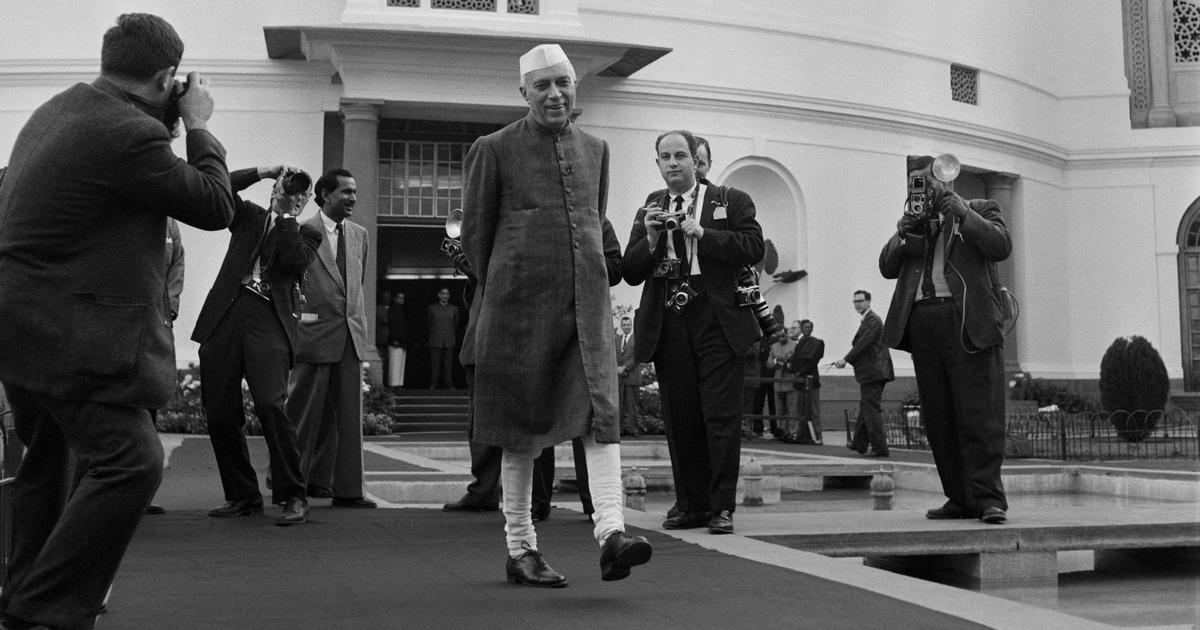
Crocker also comments admiringly on Nehru’s appearance, elegant yet understated, indeed, “grace was as natural to him as it is to a leopard”. Further, “his manners were punctilious and his courtesy fine”, and, further still, “a mixture of distinction and charm was the keynote to Nehru’s presence, be it in parliamentary debate, or around his dining table, or on such banal occasions as presenting prizes or laying foundation stones.”
Older friends have told me of the aura around the Indian prime minister in the 1950s. Walter Crocker, who was a first-hand foreign witness, writes that Nehru’s “prestige with the Indian people had something of the magical”. He notes that this “owed nothing to the projection of his personality through the mass media, for few villagers had any acquaintance with the radio or the cinema and none with TV”.
Rather, Nehru’s “incomparable prestige” owed itself to other reasons: in part that “he had been chosen by Gandhi as his political heir; in part upon the charm and aliveness of his mere presence; in part upon his devotion to the national interest as he saw it, so self-evident and so marking him off from the run of Indian politicians; the rich man who renounced his wealth and who for years lived something of the hard life of the Indian people, even travelling third class; in part upon the fact that the Indian is traditionally a hero-worshipper...”
Crocker was an Oxford-trained scholar, widely read, and widely travelled too. In the course of his life and career, he had the opportunity to observe and study European and even American statesmen at work. From this broader knowledge of world history and current affairs, he drew the conclusion that “few if any leaders in any country have attained to such a prestige amongst their own people; or have held on to it for so long. The great bulk of the people of India sensed, and they never lost the sense, that Nehru wanted only to help them and wanted nothing for himself; and that he was a ruler who had pity and kindness”.
Nehru meeting Albert Einstein at #Princeton in 1949 #bnwphotography pic.twitter.com/J0LMvAoDyH
— The 1947 Partition Archive (@1947Partition) October 10, 2017
Crocker is also appreciative of Nehru’s skills as a public speaker. He writes: “The range of his speeches, most of which were unprepared, and without a note, must be without parallel – on political matters [of] a huge variety, and also on technology, science, art, morals, history, welfare, and a host of good causes… He had an astonishing facility for speaking for half an hour or so in English, and then, without a note, repeating it in Hindustani, the translation, according to my Indian friends, being word perfect.”
We live in an age of poisonous partisanship and the debasement of language. It is thus useful to be reminded, via Crocker, that “Nehru’s contests were always about ideas, never over any personal interests of his own”, and that “for Nehru the end rarely justified the means”. (Nehru got both these traits from his mentor, Gandhi; indeed, one of the few weaknesses of Crocker’s book is that he underappreciates the influence of the Mahatma on Nehru’s character and personality.)
“Like Abraham Lincoln,” writes this wise Australian observer, “the more Nehru gained in authority the greater his compassion came… He wanted power, but he wanted it for a cause, not for himself… Nehru might have been ignorant or misguided about some matters, and about some persons, but he was always disinterested, always concerned with what he thought would help Indians or mankind.”
Walter Crocker’s book brims with insightful remarks on almost every page. First published in 1966, it remains, six decades later, the best book about Jawaharlal Nehru and his age. I cannot recommend it highly enough.
This article first appeared in The Telegraph.
Ramachandra Guha’s latest book, Arguments With Gandhi, is now in stores. His email address is ramachandraguha@yahoo.in.
We welcome your comments at letters@scroll.in.Source: Scroll.in
Own this text or image and want it removed? Send a removal (DMCA) request — we act on valid requests promptly.
View the original at scroll.in