india
Jawaharlal Nehru as a guide to India’s ‘undeclared emergency’
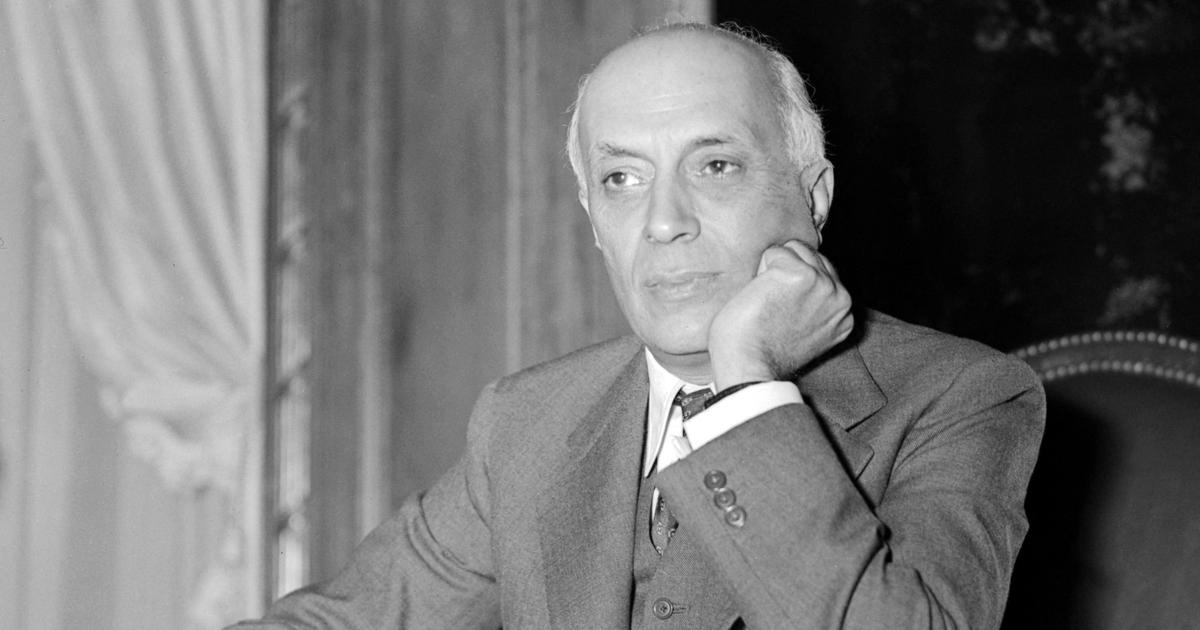
The 137th birth anniversary of Jawaharlal Nehru on November 14 provides us an opportunity to recover a Nehru for contemporary times. “There are no democratic institutions or traditions,” he wrote about the British Raj. “We have instead a well-established practice of ordinance and dictatorial rule and the suppression of the liberties of the person of speech, writing, assembly and the press.”
The Nehru who battled the Raj, which he characterised as a “police conception of the state”, speaks with uncanny precision to the contemporary moment.
Nehru’s autobiography gives us a sense of the everyday nature of life under colonial rule, if you were an activist for India’s independence. Fighting for India’s independence meant that arrest was an ever-present possibility.
There was no “settled life of routine”, Nehru writes, as “there was frequent talk of my arrest”. However, “on the whole I succeeded in getting used to the idea” of arrest and therefore “whenever arrest came I took it more casually than I might otherwise have done”.
When trying to find a historical analogy for the Modi years, we often go back to the Emergency and characterise the contemporary period as the “undeclared emergency”. However, the Nehru corpus alerts us to another historical analogy – the period of colonial rule.
To look at the past to shed light on the present is very much a Nehruvian way of thinking. As he puts it, in his magisterial Glimpses of World History, “I compare past happenings with what is taking place today, and try to find a lesson in them for my guidance.”
Nehru is notably insightful on the inverse relationship between the exercise of coercion and the legitimacy of the state. As he puts it, “Naked coercion as India was experiencing, is an expensive affair for the rulers…It exposes continually the real character of their rule, both to the people coerced and the world at large.”
He added: “Nothing is more irritating and in the final analysis, harmful to a Government than to have to deal with people who will not bend to its will, whatever the consequences. So even sporadic defiance of the repressive measures had value; it strengthened the people and sapped the morale of the government.”
When he was in prison for more than nine years, reading was Nehru’s “principal occupation”. He narrates how “whenever the superintendent visited us, he found me reading…This devotion to reading seemed to get on his nerves a little and he remarked on it once adding that as far as he was concerned he had practically finished his general reading at the age of twelve! No doubt this abstention on his part had been of use to that gallant English colonel in avoiding troublesome thoughts, and perhaps it helped him subsequently in rising to the position of Inspector-General of Prisons in the United Provinces.”
Reading was really what resulted in “troublesome thoughts”.
Despite the fighters for independence being locked up in cells, their minds ranged free and “spirits were undismayed”. But those who were ambivalent about independence inhabited “mental prisons of their own fashioning”.
Nehru quotes Henry David Thoreau to make the point that “at a time when men and women are unjustly imprisoned, the place for just men and women is also in prison”.
In his reading, he preferred non-fiction over fiction, stating that “novels made one feel mentally slack and I did not read many of them.” His letters to his daughter Indira (edited by Sonia Gandhi) are full of lists of books that he wants, ranging from Plato’s Republic to the Greek tragedies to books on contemporary history and politics.
Despite his disavowal of fiction, it too finds its place, ranging across authors like Somerset Maugham to Aldous Huxley.
Of course, reading had to contend with the arbitrary pen of the censor, which even forbade him, Spengler’s Decline of the West as the “title looked dangerous and seditious”. However, inspite of these restrictions, we have three remarkable books from his pen.
His Autobiography is at heart an account of how prison life did not inhibit the life of the imagination or the struggle for India’s independence. It gives a poetic perspective of the independence struggle going up to the early 1930s, of which prison formed an important part. For Nehru, it was an attempt to “trace out as far as I could, my own mental development and not to write a survey of recent history”.
He warns the reader that “this account is wholly one-sided and inevitably egotistical; many important happenings have been completely ignored and many important persons who shaped events, have hardly been mentioned”.
Discovery of India is an account of India as “some ancient palimpsest on which layer upon layer of thought and reverie had been inscribed, and yet no succeeding layer had completely hidden or erased what had been written previously”.
What Nehru also discovers is Gandhi and what he means for India. For him, Gandhi taught India to be fearless. British India was strangulated by “pervasive, oppressing, strangling fear; fear of the army, the police, the widespread secret service”, Nehru said. It was against this fear that Gandhiji raised his “quiet and determined voice”, resulting in the lifting of “the black pall of fear from the peoples shoulders, not wholly of course , but to an amazing degree”.
Glimpses of World History is an expansive history of the world from the birth of civilisation to the Second World War. Written as a series of letters to Indira Gandhi, Nehru frames them as “presents” from prison. As he puts it, “My presents cannot be very material or solid. They can only be of the air and of the mind and spirit, such as a good fairy might have bestowed on you- things that even the high walls of prison cannot stop.”
Glimpses is what a non-Eurocentric history would look like, a history written from the perspective of the Global South.
Secreted away in letters written across the time in prison are insights into a remarkable man, who while writing eloquently about the struggle for Indian independence comes across as a philosopher of the everyday. A little-known letter written to his sister Vijayalakshmi Pandit on intra-family conflicts needs to be quoted extensively. One can hazard that the reference is to the conflict between Nehru’s sister and his daughter.
“Little things sometimes touch and ruffle our tempers and disturb the cooperation that should exist. We lead an abnormal life- in and out of goal- and those who are out have the more difficult time for they have to shoulder many a burden when their heart is not in it. And so sometimes tempers get frayed and a spirit of non-cooperation steals in and that of course is not only unbecoming but it makes matters worse. Almost unconsciously we allow ourselves to become victims of trivial circumstances and the harmony that should be life-even though it be tragic-becomes marred and we develop the hard look that is neither beautiful nor helpful. That is a true sign of age! If we presume to dabble in big things, we have to carry the shadow of bigness even in our little undertakings. We cannot control life, the joy and sorrow of it, the achievement or otherwise, but one thing we ought to be able to control, and that is our attitude to it. We can, I believe , make a work of art of our lives, a song or a beautiful melody, even though that song may clutch at our throat and bring tears to our eyes. No one can deny us that artistry of living if we are ourselves capable of it. If we are capable; it is a big if! Not to reject life but to accept it in all its fullness, and yet to go through it finely and with light steps and refusing to allow it to besmirch us. That is a worthwhile ideal, a difficult undertaking, and the very few who have the good fortune to approach it can never regret the choice. Success if it comes, comes worthily, with no tinsel or vulgarity; failure itself approaches with noble and tragic mien.”
This letter is a poignant plea to those in larger public struggles to never forget to “carry the shadow of bigness even in our little undertakings”. One is enjoined to go through life with “light steps”, without allowing it to “besmirch us”.
Today’s writers from prison ranging from Umar Khalid to Sudha Bharadwaj, Anand Teltumbde to Sharjeel Imam, Arun Ferreira to Seema Azad are all heirs of the Nehru of the prison days. Nehru spent nine years in a colonial jail. Umar Khalid has spent six years in jail in Modi’s India.
Just as Nehru evoked the injustices of the colonial state, today’s political prisoners evoke the injustices of the “undeclared emergency”.
For Varavara Rao, the kind of poetry the contemporary age demands is:
“The poetry with a spine
That can stand up to a system
And hold it accountable.
The poetry that refuses power
The poetry that challenges the state.”
The vision that motivates those who fight against the “undeclared emergency” parallels the vision of the fighters for India’s independence. As Umar Khalid puts it, “Ours is a battle for a vision – of a time in our society when some will not be more equal than others. This conviction is what makes this pain bearable.”
He continues:
“It’s almost Christ like, or Bhagat Singh like. Both sacrificed their lives or causes of the oppressed and there is a beauty in knowing that this is the lineage of which I’m a part, in a history that shall be penned for the future.
“This is why I wake up every day to the lines of Bhagat Singh that I’ve etched on my prison wall:
Every tiny molecule of ash is in motion with my heat
I am such a lunatic that I am free even in jail.”
These are reasons enough as to why Nehru is an indispensable guide to how to live life under the undeclared emergency.
Arvind Narrain is the author of India’s Undeclared Emergency: Constitutionalism and the Politics of Resistance.
We welcome your comments at letters@scroll.in.Source: Scroll.in
Own this text or image and want it removed? Send a removal (DMCA) request — we act on valid requests promptly.
View the original at scroll.in