india
In filings by US lobbying firm, a glimpse of Modi government’s strategy to engage with Trump
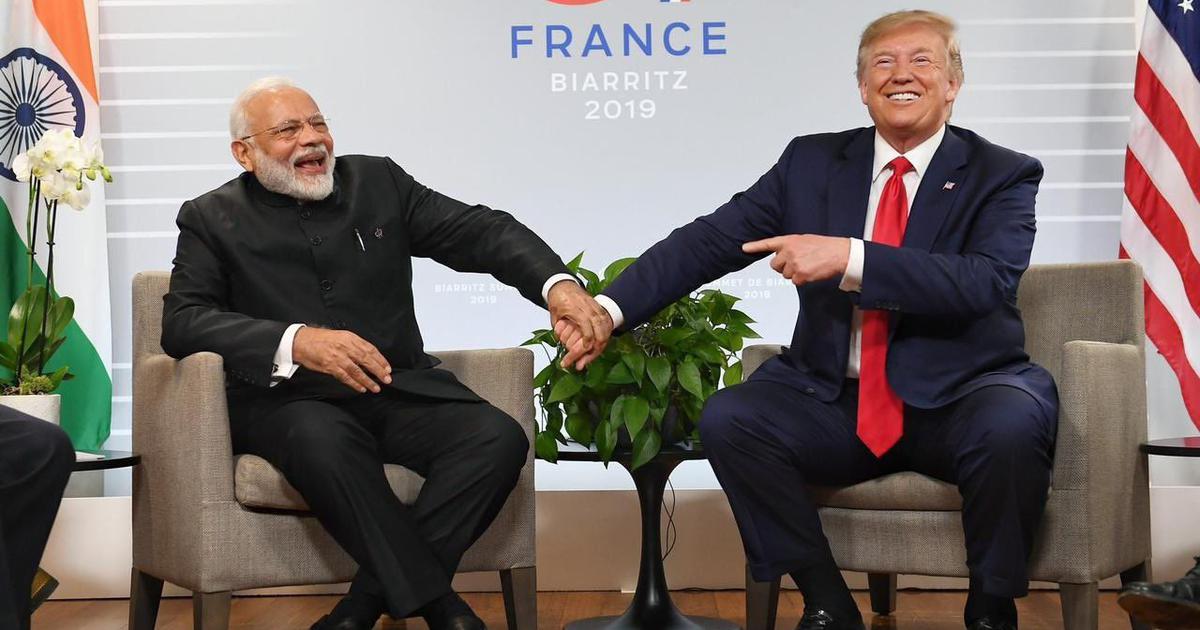
Flagging social media posts by Prime Minister Narendra Modi. Forty-four phone calls to “discuss US-India relations” between Indian officials and senior members of the American government in the first six months of 2026. A pitch to a Fox News host to interview the Indian ambassador to the US.
These were among the activities mediated by SHW Partners LLC, a major lobbying firm hired by the Indian embassy in the US after Donald Trump returned to the White House for a second term in January 2025.
The Indian embassy also hired Mercury Public Affairs as a lobbyist, The Indian Express reported this week. Both firms were headed by close aides of Trump, the paper said.
A closer reading of the public disclosures filed under the US Foreign Agents Registration Act by the lobbying firm paints a vivid picture of the purpose and nature of communications between India and the US.
These filings, which detail political activities undertaken on behalf of foreign principals, show that more than two dozen exchanges between officials of the two countries involved discussions related to the media or social media.
Managing perceptions
“A lot of foreign governments spend a lot of money when it comes to influencing Washington’s policies,” said Raqib Naik, Executive Director of the Center for the Study of Organized Hate, a Washington-based think tank. However, what is surprising is how “keen and anxious” the Indian government has been to portray a strong US-India front under the second Trump administration, even as the relationship between the countries has occasionally been contentious.
Just over the past year, for example, over 100 Indian immigrants in the US, including women and children, were deported back to India during the Trump administration’s crackdown on undocumented immigrants. The men were in shackles. Two months later, in April, President Trump reposted a conservative host calling India a “hell-hole”. The Indian Ministry of External Affairs said the comment was “uninformed, inappropriate and in poor taste”.
Last year, after Trump claimed to have brokered a ceasefire between India and Pakistan, Indian officials, including Prime Minister Narendra Modi himself, maintained that the decision was made solely by the two countries, devoid of any mediation.
PRESIDENT TRUMP: “After a long night of talks mediated by the United States, I am pleased to announce that India and Pakistan have agreed to a FULL AND IMMEDIATE CEASEFIRE. Congratulations to both Countries on using Common Sense and Great Intelligence. Thank you for your… pic.twitter.com/ANaLBOABMo
— Dan Scavino (@Scavino47) May 10, 2025
Through it all, social media has increasingly become a factor that influences US-India policy, said Naik, and more so, relations – or at least what is perceived of them.
Joyojeet Pal, a professor of information at the University of Michigan who researches the role of social media in mainstream politics, such real-time media management by the Indian government is not surprising.
But it is rarely about “real trade issues that impact everyday people”, such as the rising costs of basic necessities, he said. Explained Pal, “The idea of having social media in global diplomacy is much more about signalling than about substance.”
According to the FARA disclosures, several email and telephone exchanges between New Delhi and some of the highest-ranking members of the Trump administration involved discussions about the “media coverage” of India’s Operation Sindoor. They also discussed a “pitch” for an interview of the Indian ambassador to the US to a Fox News host.
The FARA disclosures do not name the Indian officials who initiated or were involved in the conversations. But they reveal who the emails or phone calls were directed to.
Some of the calls by the unidentified Indian officials to White House staff were to “flag social media posts by Prime Minister Modi”. There were as many as 44 phone calls to “discuss US-India relations” between Indian government officials and senior members of the American government such as US Secretary of State Marco Rubio, US Trade Rep. Jamieson Greer, and now-former White House Chief of Staff Susie Wiles in just the first six months of 2026.
Fox interview
SHW Partners’ first task on behalf of India was registered in April 2025, according to the FARA filings.
Around the same time, a major conflict broke out between India and Pakistan. On April 22, 2025, terrorists killed 26 people, most of them Hindu tourists, in Kashmir. India blamed Pakistan-backed militants for the attack. Pakistan rejected India’s allegations and denied involvement in the attack.
Two weeks later, on May 7, India launched Operation Sindoor, striking nine locations in Pakistan and Pakistan-administered Kashmir that it identified as “terrorist infrastructure”. This included sites India said were being used as bases by the Lashkar-e-Taiba and Jaish-e-Mohammed terror groups.
Pakistan condemned the attacks, accused India of targeting civilian areas and claimed that civilians had died in the strikes.
Pakistan launched drone and missile attacks on Indian locations. Artillery fire was exchanged. India subsequently targeted Pakistani military installations, including airbases, bringing the nuclear-armed neighbours to the brink of a wider war.
On May 10, Trump announced on Truth Social that India and Pakistan had agreed to an immediate ceasefire following discussions mediated by the US.
In the days preceding and following that announcement, FARA filings show, India had nearly half a dozen calls with Washington to discuss a specific aspect of its operation: its “media coverage”.
On May 7, 2025, through SHW Partners, a call was registered by the Indian government to long-time Fox News host Bret Baier. The purpose of the call, according to the filing, was to “pitch [a] media interview with Indian Ambassador to the US Vinay Kwatra to discuss Operation Sindoor”.
Kwatra appeared on Fox News that same day. The interview was brief, and it was not with Baier but with another anchor, Gillian Turner. In the interview, Kwatra said India sought de-escalation following its strikes in Pakistan.
"Indian operation was aimed at bringing accountability, Justice," Indian Ambassador to US Vinay Mohan Kwatra @AmbVMKwatra tells Fox News on Pahalgam terror attack pic.twitter.com/lwQ0mkj0eq
— Sidhant Sibal (@sidhant) May 8, 2025
On May 10 – the day Trump made the announcement – there were four calls between India and senior US officials to, again, “discuss media coverage of Operation Sindoor”. Two of them, the records show, involved calls with Ricky Gill, then the US National Security Council’s Special Assistant to the President and Senior Director for South and Central Asian Affairs, and Susie Wiles, who was White House Chief of Staff at that time.
Nearly three weeks later, on June 18, 2025, there was another call concerning media coverage of the operation and the “status of US-India trade conversations” between Indian officials and Wiles.
Gaza Peace Plan
The Indian government’s media-related correspondence with the US goes further back. Nearly two years before it hired SHW Partners, in June 2023, Indian officials sent 11 emails to the offices of various US politicians.
Facilitated by Cornerstone Government Affairs, another Washington-based lobbying group, the list included six senators and three US representatives – one of whom was the then-chief of staff to Congressman Ro Khanna. The purpose of each email, the filings show, was listed as “to discuss a potential Tweet regarding PM Modi’s visit”.
Modi visited the US from June 20- June 23, 2023, which included leading the International Yoga Day celebrations at the United Nations headquarters in New York City, and meeting with then-US President Joe Biden.
From April 2025 to June 2026 – when the FARA public disclosures runs out – all correspondence by the Indian government to US officials were facilitated by SHW Partners, which is headed by Jason Miller, a long-time Trump adviser. The Indian embassy in Washington had a monthly contract with the firm worth $150,000, or approximately Rs 1.4 crore.
Between September and October 2025, four other calls were made to four White House officials. The stated purpose of each was to “flag social media post by Prime Minister Modi”. Although the posts are not identified in the filings, a review of Modi’s X account may offer some clues.
On September 10, 2025, the day of the first two calls, Modi posted a message after Trump announced that the two countries were resuming trade negotiations. This followed Trump’s decision to impose 50% tariffs on Indian goods, including an additional 25% linked to India’s purchases of Russian oil.
“India and the US are close friends and natural partners,” Modi tweeted. I am confident that our trade negotiations will pave the way for unlocking the limitless potential of the India-US partnership. Our teams are working to conclude these discussions at the earliest. I am also looking forward to speaking with President Trump. We will work together to secure a brighter, more prosperous future for both our people.” Trump subsequently shared the post.
India and the US are close friends and natural partners. I am confident that our trade negotiations will pave the way for unlocking the limitless potential of the India-US partnership. Our teams are working to conclude these discussions at the earliest. I am also looking forward… pic.twitter.com/3K9hlJxWcl
— Narendra Modi (@narendramodi) September 10, 2025
The other two calls to flag Modi’s social media posts were made on October 9, 2025, the records show. The Indian prime minister made several posts that day. Three of them concerned US President Donald Trump’s Gaza Peace Plan – a 20-point plan that included an immediate ceasefire in Gaza, the release of Israeli hostages and Palestinian prisoners, and a controversial reconstruction programme for Gaza.
One of Modi’s posts that day read: “We welcome the agreement on the first phase of President Trump’s peace plan. This is also a reflection of the strong leadership of PM Netanyahu. We hope the release of hostages and enhanced humanitarian assistance to the people of Gaza will bring respite to them and pave the way for lasting peace”.
We welcome the agreement on the first phase of President Trump's peace plan. This is also a reflection of the strong leadership of PM Netanyahu.
We hope the release of hostages and enhanced humanitarian assistance to the people of Gaza will bring respite to them and pave the way…
— Narendra Modi (@narendramodi) October 9, 2025
Both Trump and Israeli Prime Minister Benjamin Netanyahu were tagged in the post. The other two posts were about Modi’s calls with the two leaders to “congratulate” them.
Up until June 2026 – when the publicly available data runs out – the other lobbying firm hired by Indian authorities, Mercury Public Affairs, seemingly only coordinated for the US Embassy of India, while SHW Partners did so for the Republic of India, FARA records show. There are no explicitly media management-related activities listed in the Mercury Public Affairs public filings.
India terminated its contract with SHW Partners in June after its head, Jason Miller joined the Trump administration as a “special government employee”. The Indian Express reported
We welcome your comments at letters@scroll.in.Source: Scroll.in
Own this text or image and want it removed? Send a removal (DMCA) request — we act on valid requests promptly.
View the original at scroll.in