india
From a hilltop in Mumbra, Khan Shamim Akhtar has made Gaza his subject
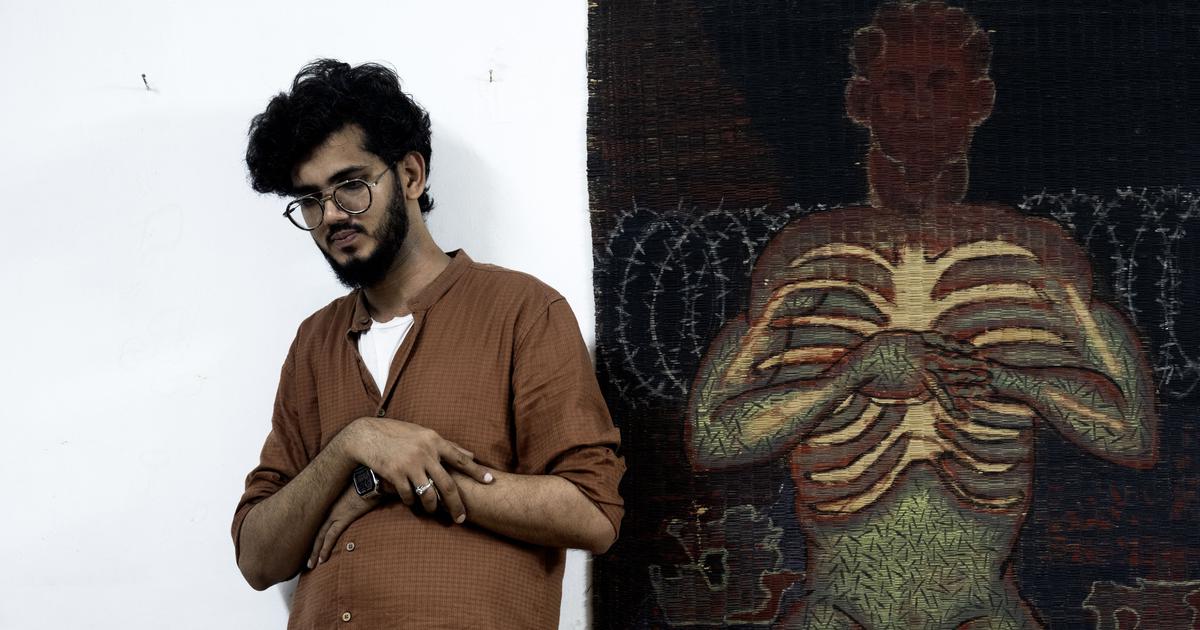
One rain-soaked July afternoon, I met the artist Khan Shamim Akhtar in Mumbra, a Muslim ghetto on Mumbai’s outskirts. Fresh from his first solo exhibition, The Cenacle on the Sajjada, held in the city at the end of 2024, Akhtar is among a small number of Indian artists who have made work about Gaza, and perhaps the only one to have sustained it consistently.
Sumesh Sharma, the director and curator of Strangers House, where the exhibition was held, told me that the artist had come to the attention of Hindutva student groups. Sharma cautioned that artists who take such risks at the cusp of their careers “must be protected by all means”.
The past couple of years have been busy for Akhtar, who holds a Master’s in Fine Arts from the city’s JJ School of Art. In 2024, he won the Artist Altaf Award and, three months later, the Takshila Fine Arts Scholarship.
Last year, he was selected as a curator for the Students’ Biennale at the Kochi-Muziris Biennale. Mario D’Souza, Director of Programmes at the Kochi Biennale Foundation, said he wanted students to see a recent graduate succeed through honest, deeply intentional work.
In November, Akhtar received the South Asia Speaks Prize, which recognised him for his exceptional creativity and potential to break through. “This award makes me feel seen,” Akhtar said. “It also makes me feel that, no matter the risks, I might be doing something right somewhere.”
In Mumbra, Akhtar works from a studio on a hill, hemmed in not by other hills but by buildings packed together like passengers on a Mumbai local train. Their simple, block-like construction reflects the urgency with which housing was built for successive waves of families uprooted by anti-Muslim violence.
As I climbed the steep steps, I found Akhtar waiting at the top, pleasantly surprised that I had found the place without calling to ask for directions. Though small, the studio gets plenty of natural light through a large window. Paint bottles, unwashed palettes, and a black fibre-steel tray of brushes and sponges clutter one side of the room. Two of his paintings hang on a white wall: an unfinished work and one titled Stone of Survival.
‘It’s insular’
Akhtar was born in 1994 in Kurla in eastern Mumbai, a year after the communal riots that followed the demolition of the Babri Masjid in Ayodhya by Hindutva supporters. His childhood was shaped by the memory of violence and displacement.
“My parents had only chilli powder to protect themselves,” he told me. They fled to Mumbra, seeking safety in the ghetto, and have remained there ever since.
After his father lost his small neighbourhood garage and turned to scrap dealing, money was always short. In Class 5, aaged nine, Akhtar, who has five siblings, was pulled out of his relatively upscale, English-medium school and sent to a madrassa.
His mother, Najma Khatoon, became his anchor. She taught him Urdu, which helped ease his transition to the new school. “I have dyslexia and find reading and spelling in English difficult,” Akhtar said. “Urdu helped me learn better.”
Art entered his life almost by accident. “I was a backbencher, and once, when I was distracted during a lecture, I sketched a face on my desk,” he recalled. An art teacher discovered the sketch and became his first mentor, later guiding him to JJ.
Living in Mumbra makes Akhtar feel safe, though it has its limits. “It’s insular,” he said with a shrug. “There’s no space for intellectual stimulation. And it’s neglected because we’re invisible to the administration.”
What Mumbra does offer is space, plenty of it, which Akhtar needs: his favourite material is korai, a reed-like grass that grows along riverbanks. Once dried, people often weave it into eco-friendly mats and other household items, but in Akhtar’s hands, the mats become something else entirely.
His studio is full of them, rolls and rolls, some standing to attention, others stacked one on top of the other. For Akhtar, whose debut series, Reveries Before The Salvation, studied distractions during prayer, korai mat is a medium that expresses his Muslim identity.
“I used impressions of my janamaz [prayer mat] for texture when I painted on canvas for my debut series,” he said. Korai is a challenging medium, he added, but he felt it was exactly right for the Gaza paintings.
Stone of Survival, the four-foot cut-out on the wall ahead of us, is among his most striking korai works. It depicts a fatigued and malnourished man clutching a stone tied around his stomach, his eyes sunken, his shoulders hunched under the weight.
The painting belongs to a series called Starvation that Akhtar made in response to three catastrophes unfolding simultaneously: the genocide in Palestine, the civil war in Sudan and the deadly violence in the Democratic Republic of Congo.
Making art has not always been easy. After high school, he worked for a courier service and packaged bread and butter at a bakery. “The bakery job earned me Rs 30 to 40 per day,” he said. “It was a small amount, but it kept me from asking my father for money for art supplies.” He painted Ganpati pandals to pay his fees for the art teacher training course at JJ.
As I looked at the wall, Akhtar stood and reached into a pile of works. “It is called Humanity in a Bag,” he said, unrolling it across the floor. Even in galleries, it is shown this way. Painted on a korai mat, it gives a top-down view of a white plastic bag holding the emaciated head and a dismembered limb of a child. The face stares back at the viewer.
“It gives me goose flesh,” Akhtar said.
Akhtar is consumed by the genocide, scrolling through social media and keeping half an eye on Al Jazeera throughout the day. For relief, he walks to his local masjid, where he can speak freely with others who are mourning.
RIP Book, shown at his debut show at Strangers House, is both a physical volume and a video installation. It lists over 3,500 names of the dead, sourced from Gaza’s Ministry of Health and arranged by age.
“During the installation, I would encourage viewers to flip to the page where the dead share their own age,” he said. The same names are projected onto a mirror, scrolling down the wall and onto the floor.
What Akhtar brings into his art is not only the death toll but also the destruction of future generations. Unrolling Bereaved, his most startling work, seven feet by three on korai mat, he described how he made it.
He began by stamping red triangles across the entire reed surface with a wooden block. With a friend’s help, he then traced the outline of his own body, which became the central figure around which the composition developed. Finally, he painted over the stamped pattern.
“Layer by layer I painted over the geometric forms as they disappeared beneath the paint, with the intention of depicting a culture’s erasure,” he said. Only fragments of red survived; the reed’s texture further pixelated the form, and in places the flecks resembled blood.
Bereaved is not where Akhtar’s engagement with these questions ends. In his current series, he focuses on famine as a political weapon. “I started questioning famine, all the way back to Churchill’s decisions in Bengal in 1943, and realised that when I look at Sudan or Israel’s blockade of food, little has changed,” Akhtar said. "
He plans a relay of gatherings across Mumbai, Delhi, Kolkata and Kochi, where participants will fast with him and inscribe the names of the dead onto grains of rice, each legible only under a magnifying glass. He hopes the grains will eventually form a public mural, with a companion book recording the dead of Gaza by name, age, and gender.
Khan Shamim Akhtar is the winner of the South Asia Speaks Prize 2026.
Nusrat F Jafri is a cinematographer with two decades of experience and the author of This Land We Call Home and co-author of My Tyebi. She was a 2021 South Asia Speaks Fellow.
We welcome your comments at letters@scroll.in.Source: Scroll.in
Own this text or image and want it removed? Send a removal (DMCA) request — we act on valid requests promptly.
View the original at scroll.in