india
Can a politician’s memoirs ever be ‘personal’?
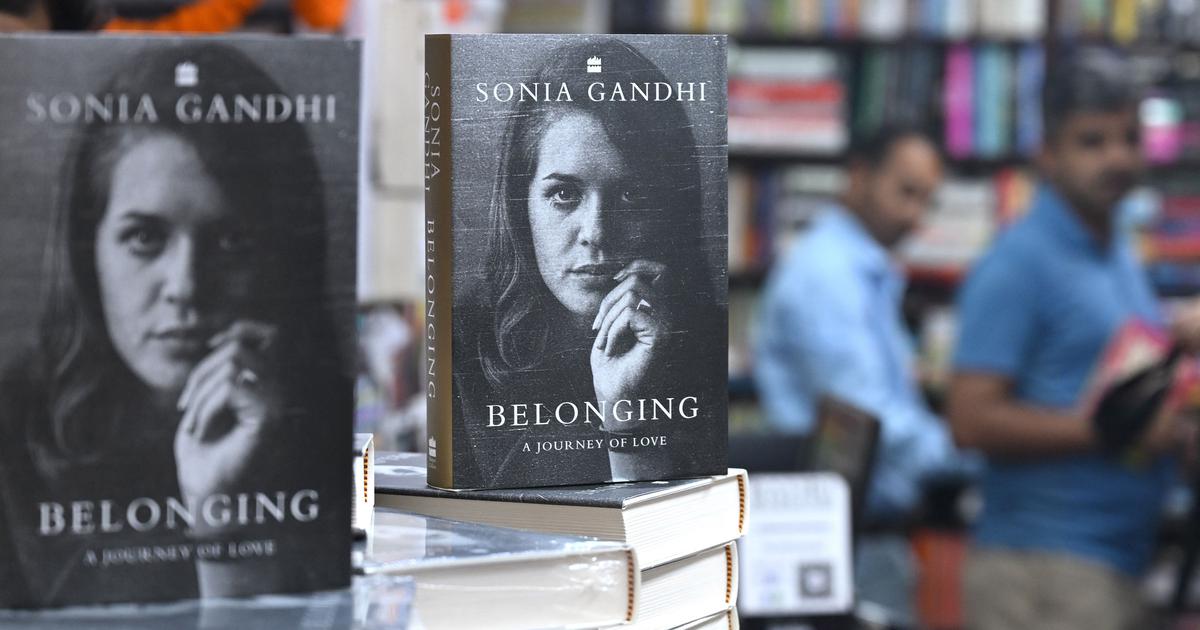
This week was eventful for political reporters. Former Congress President Sonia Gandhi’s memoirs, Belonging: A Journey of Love, arrived in the market on Tuesday.
Almost immediately, towering Congress leaders as well as ordinary workers queued up to buy their copies. In typical Indian fashion, at least some of them seemed more keen to be seen with the book at the Bahrisons Booksellers store in central Delhi’s Khan Market, where TV cameras were waiting to interview buyers, than actually reading it.
Like clockwork, spokespersons from the grand old party urged people to leave politics “aside” while reading Sonia Gandhi’s book and see it as “her truth, her life story”. And, to be fair, it is indeed written that way.
The years that Sonia Gandhi has herself spent in the political arena, winning elections and running governments, make up less than a fifth of the book. Most of it is about the lengths that she went to out of her love for Rajiv Gandhi, whom she met when they were students at Cambridge.
While she dotes on her husband throughout, she is quite candid in her sketches of the other Gandhis. Readers get to discover just how domineering Indira Gandhi was, both as prime minister and as the matriarch of the Gandhi household.
Sonia Gandhi’s memoirs give readers some glimpses of the difficulties she faced as a 21-year-old Italian woman who married into such an important Indian family. It also underscores the conservative and patriarchal values that bind the two cultures, which are otherwise vastly different from one another.
But those years Sonia Gandhi spent first fitting into the Gandhi family and then building her own family within it saw Indian democracy being unmade and remade, often with the Gandhis in the eye of the storm. Far from sidestepping those events in the book, she codes them in accordance with the politics of the Congress.
The Emergency is, therefore, framed as a regrettable period in which the government committed excesses against citizens. But, Sonia Gandhi reminds us, it was declared “constitutionally”. Her description of the build-up to that period could convince anybody that imposing the Emergency was a terrible thing that had to be done. It almost got me.
This is a recurring pattern. Operation Blue Star, the pogrom against Sikhs, the injustice to Shah Bano and other Muslim women, the bloody campaign against the Babri Masjid – all long-lasting scars inflicted on Indians in those years are similarly framed. Readers are repeatedly told that the Gandhis, certainly Sonia Gandhi’s faction of the family, always acted with the best of intentions.
One should arguably expect nothing else from such a seasoned politician who still has so much skin in the game. After all, Sonia Gandhi is an MP herself, and so are both her children who firmly control India’s largest Opposition party. So, why should a family so steeped in politics insist on placing Belonging outside politics?
“I chose to write a personal memoir, one for which politics is the background, a kind of framework,” Sonia Gandhi states in her prologue.
I have spent most of this week trying to understand what this political framework is. At times, in conversations with my colleagues and friends, I have debated the worth of fretting over the politics of a book that is so avowedly “personal”. But maybe that is its politics.
For some years now, particularly since the Gandhis lost power at the Centre, the Gandhi surname has been dragged into the rough and tumble of Indian politics like never before. Prime Minister Narendra Modi, himself a master at positioning himself above and beyond his opponents, has been the chief beneficiary of this development.
The Gandhis would, naturally, like to reverse this tide and Sonia Gandhi’s memoirs are a step in that direction. Its politics lies not only in its efforts to humanise its protagonists by telling their fascinating love story, but also in poking holes in Modi’s own bildungsroman.
“Mr Modi’s origins may not have been as humble as his PR [public relations] team has made out in marketing his image,” Sonia Gandhi writes about him while stating that her concern for India’s poor is no less than his.
As “personal” as the book may be, its politics is clear: the Gandhis, with their stories of love, sacrifice and goodness, are taking on the opponents who pejoratively call them a dynasty.
Clearly, a politician’s memoirs are never “personal”.
Here is a summary of last week’s top stories.
- Breathing hazardous air. The average Air Quality Index in Delhi worsened to the “severe” category last week. While several neighbourhoods were recording AQIs of more than 400 since November 9, the average air quality in the national capital also crossed the mark on Friday.Private air quality monitors, which calculate the data differently, had been recording even higher AQI levels in Delhi, categorising the air as “hazardous”.The average AQI in adjoining cities of Noida, Gurugram, Ghaziabad and Faridabad were also in the “severe” or “very poor” categories. Stage 3 anti-pollution restrictions under the Graded Response Action Plan are in place in the National Capital Region.At least 80 of the 100 most polluted cities globally during the week were in India, showed data from AQI.in.How an El Niño winter could worsen pollution in Delhi, writes Vaishnavi Rathore.
The state of the economy. India’s retail inflation, measured by the Consumer Price Index, increased to 6.09% in October from 5.5% in September. This is the first time in two years that inflation has risen above 6%, which is the upper tolerance limit set by the Reserve Bank of India.
Retail inflation has been surging for 12 consecutive months since bottoming out at 0.04% in October 2025. This was because of rising food prices and an unfavourable base effect.
Food inflation has increased to 8.9% from 7.7% in September, showed data from the Union government.
Onions, sugar, rice: Why India’s food staples have gotten costly, explains Vijay Jadhav.
Climate change. The year 2026 is on track to be one of the four warmest years on record, the World Meteorological Organization said. The other three years were 2023, 2024 and 2025.
The global average temperature between January and September this year was higher than the full-year averages in 2025 and 2023, and only “somewhat lower” than 2024, which is the warmest year on record.
The report also highlighted India’s heat waves as major extreme weather events this year. “An estimated 146.5 million people in India were exposed to extreme heat in an April 2026 heatwave,” it said.
Also on Scroll last week
- Watch: Helle Lyng on visa revocation: ‘I was told it is on orders from above’
- From Bachchans to Modi: What Sonia Gandhi says (and leaves out) in her book
- Why newfound warmth between Meiteis and Nagas may not advance cause of Manipur peace
- They lost their homes as Delhi developed. A pavement became a shelter for disabled like them
- Why the decline of traditional midwifery is a blow to rural women’s health
- Why a surrendered Maoist leader is not welcome in his village
- ‘Disheartening to see right-wing Indian Americans’: Comedian Nimesh Patel on a divided diaspora
- Uncivic sense: Entitled behaviour starts from the top – India’s leaders must set a better example
- The film in which Raavan is the hero rather than the villain
- ‘I Play Rocky’ review: A salute to Sylvester Stallone and a love letter to Hollywood
Follow the Scroll channel on WhatsApp for a curated selection of the news that matters throughout the day, and a round-up of major developments in India and around the world every evening. What you won’t get: spam.
And, if you haven’t already, sign up for our Daily Brief newsletter.
We welcome your comments at letters@scroll.in.Source: Scroll.in
Own this text or image and want it removed? Send a removal (DMCA) request — we act on valid requests promptly.
View the original at scroll.in