india
A new book describes Delhi University students’ participation in the freedom movement
We turn our attention to the role of the students of Delhi University in the freedom struggle and sit with Durga Chand, the grandson of Amir Chand, who was one of the four hanged to death for the Hardinge bomb case. His family runs M/S S Chand and Company Pvt Ltd, a leading publisher of school and college textbooks. The company, founded in 1917, aimed to provide cheap school and college textbooks to Indian students. In a market dominated by European authors and publishers, its founder Lala Sultan Chand encouraged Indian professors to write in a language easily understood by local students and to market their works at affordable prices. We ask Durga Chand about his grandfather.
“Master Amir Chand was an ex-Stephanian and one of the four hanged by the British in 1915 in the infamous Hardinge bomb case,” he tells us proudly.
He recalls the details of the case. On December 23, 1912, a small group of revolutionaries led by Rash Behari Bose hurled a bomb at Viceroy Lord Hardinge as he rode in procession on an elephant through Chandni Chowk. The bomb blew up the howdah in which Lord Hardinge sat and killed the attendant standing behind it. Lord Hardinge had splinters in his arms and legs and had strips of flesh peeling off his shoulders, while Lady Hardinge escaped unhurt. “Of the conspirators, Master Amir Chand and Master Awadh Behari were ex-students of Stephen’s. The others were Bhai Balmukund, Basant Kumar Biswas and Lala Hanuwant Sahai,” says Durga Chand.
In the ensuing chaos, the collaborators fled in different directions. Such was the secrecy surrounding the whole operation that it was not till February 1914 that they were arrested. Lala Hanuwant Sahay was sentenced to life imprisonment in the infamous Cellular Jail in the Andamans, and the other four were hanged to death in May 1915 in the Delhi Central Jail. Rash Behari Bose escaped and fled to Japan, where he settled down.
St Stephen’s College’s contribution to the flowering Independence movement was not limited to this incident alone. CF Andrews, who taught English at St Stephen’s and was a close friend of Mahatma Gandhi, was among those responsible for persuading Gandhi to return to India and take over the reins of the freedom struggle, having specifically gone to South Africa for this purpose. Similarly, another English instructor, CF Young, had written an article in the college magazine condemning the Jallianwala Massacre, which was a big thing then. Besides this, revolutionaries like Lala Har Dayal and Sir Chhotu Ram were also Stephanians.
Similarly, the Ramjas College hostel was, in the late 1920s, a hotbed of nationalistic activities, and the revolutionary Chandra Shekhar Azad, disguised as a Sikh, used the premises to hide from the police.
In November 1940, the All India Students’ Federation (AISF) called for a general strike in the university to protest against the repression unleashed against the leaders of the freedom movement by the British, particularly the arrest of Nehru. Muqimuddin Farooqui, a student of St. Stephen’s College, led the strike.
Having joined it in 1934 after his matriculation, Farooqui completed his master’s degree in 1940 and enrolled to study law. He was then the only student in the college who wore khadi, and students greatly respected him. He was the president of the Criterion Club (as the student union was then called), and was the first to be elected twice in a row, which was quite unusual. As he took the lead in organising the strike, Gwyer [Sir Maurice Linford Gwyer was a British lawyer and judge who, as the chief justice of India from 1937 to 1943, also took over in 1938 as the fifth vice chancellor] called him and G Sanghi, the club secretary, expelled them both and cancelled Farooqui’s postgraduate degree. This caused an uproar among students, and protests followed wherever Gwyer spoke. Bowing to pressure, he called Farooqui, handed him a piece of paper and asked him to write an apology. But Farooqui tore up the paper, walked out and joined the freedom movement full-time.
These were, however, sporadic incidents. The involvement of a large body of students in the freedom struggle took place when, on 8 August 1942, the Bombay session of the All India Congress Committee passed a resolution asking the British to quit India. In his speech, Gandhi asked his countrymen to do or die, resulting in a colossal backlash by the British. The police arrested the entire Congress leadership within hours of the speech, and protests erupted across the country. The slogan “Angrezo Bharat Chodo” strongly echoed across the country and in the precincts of the University of Delhi.
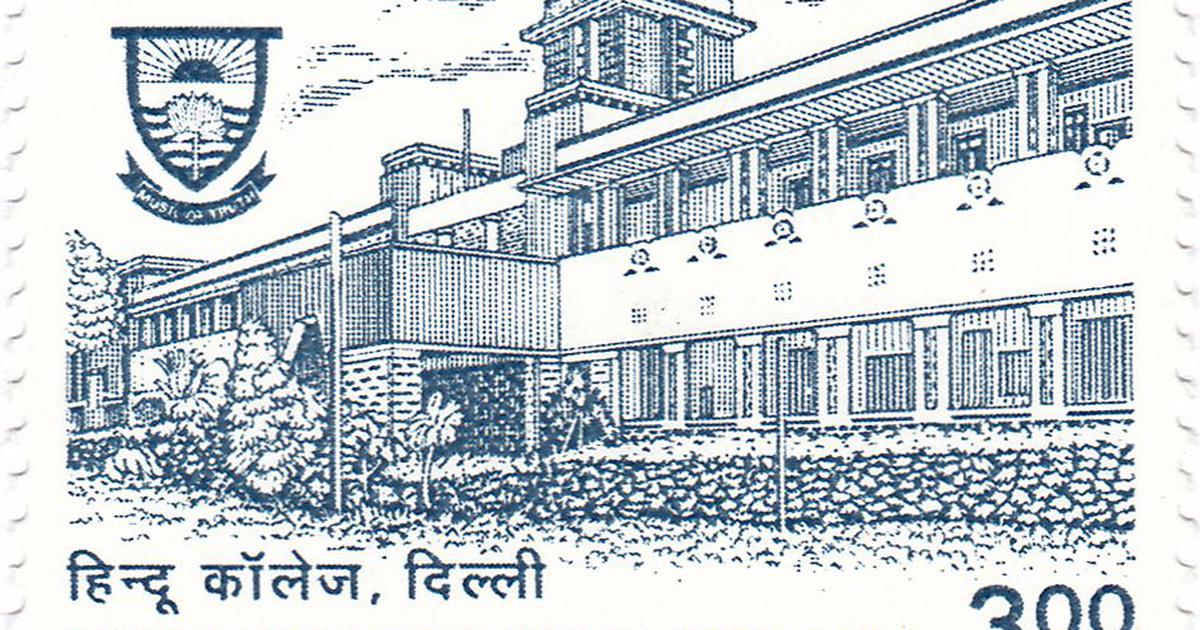
On August 10, 1942, students from Hindu College and some girls from Indraprastha College gathered outside St Stephen’s College. They urged Stephenians to join them in protesting the arrest of national leaders, and some did. The agitated crowd marched through the campus and arrived at Alipur Road, where they encouraged more students from Indraprastha College to join them. The principal locked the college gates to prevent the girls from leaving, but they scaled the walls and joined the procession anyway.
At the Kashmere Gate square, students raised clenched fists and shouted themselves hoarse as the crowds swelled, with locals joining in. Lathi-wielding policemen, reinforced by armed guards, stopped them. Stationed at a corner, they swung into action as the agitated crowd charged at them. While the locals dispersed, a group of students rushed to the Hindu College grounds for safety, and the police followed in hot pursuit. As the students scampered in, Principal Thadani, sensing trouble, stood at that gate and closed it behind him to prevent the policemen from entering the premises. Then, he asked the authorities to leave his students alone. That day, Thadani proved his mettle for the worthy cause.
Retribution came swiftly, and the police arrested many students. Yet the agitation continued, marked by arson and damage to government property. Alarmed, the Delhi administration sent a note to Delhi Chief Commissioner AK Akswith. The senior superintendent of police AV Kilburn suggested stern action against the students of Ramjas College. He asked the principals of Ramjas and Hindu colleges to restrain their pupils or risk losing government grants, and formally cautioned Thadani that he would be held accountable for any failure to do so.
The fire did not die down, and soon Indraprastha College students started agitating by picketing the houses of members of the viceroy’s executive council. Their students’ union decided not to organise any academic or entertainment programmes in 1942; instead, against the principal’s orders, they started a charkha association under the college’s Social Service League. By 1944, they bought five charkhas, and the teachers donated an equal number.
Hindu College invited prominent leaders to address students through its College Parliament, established in 1935. Nehru, Jinnah, Sarojini Naidu and Subhas Chandra Bose addressed the students in this forum.
On September 7, 1942, the principal of Indraprastha College, Kalavati Gupta, wrote a letter to the parents of its students asking them to ensure that their wards refrain from participating in picketing and missing classes. In case they could not do so, the college, she said, would be forced to take action against them.
“In your interest, I am anxious to avoid invoking the help of any outside body or to take any unpleasant steps, and therefore, I am seeking your cooperation,” her letter stated.
Apparently, nothing worked, and colleges continued to simmer with heated anti-British fervour. Students and professors were arrested. Colleges often remained shut. In September 1942, the government cancelled the wheat permits of Stephen’s, Hindu and Indraprastha. The apparent reason was that the girls of Indraprastha had sent rakhis to their Muslim brethren (Muslim soldiers). The British sought to drive a wedge between the two communities, viewing the attempt at forging unity as an attempt to undermine their policy.
Newspapers called it an “omnibus vendetta for any sins of omission or commission”. The consensus was that even if there was political warfare against the government, cutting off food supplies was not a legitimate weapon against students. Despite strong public opposition, the ban remained in effect until 1945. But even this drastic action did not deter the university’s youth from supporting the nationalist cause. In 1946, Sameeruddin Khan, a Stephanian, along with 100 students, took down the Union Jack from the college flagstaff and marched through the campus raising slogans.
When Independence finally came, it was a cause for much rejoicing. Yet it was tempered by the fact that the violence unleashed on the streets of Delhi in the aftermath of Partition left the streets of the areas around the campus riddled with corpses.
The disturbed situation meant that no convocation was held in 1947. On August 15, Dr VKRV Rao hoisted the tricolour, as Gwyer, who was supposed to hoist it as vice chancellor, was then in England. Many say he left on purpose, as he wanted to avoid the potentially embarrassing situation of an Englishman presiding over a function in which the Union Jack was lowered.
The first year after Independence presented a massive challenge to Delhi University because an institution with just 3,400 students suddenly had to cope with the rush of refugees from Pakistan who had left their education midway to escape to India to save their lives.
Excerpted with permission from DU @ 100: An Anecdotal History, Seema Gupta and Neelesh Kulkarni, Westland.
We welcome your comments at letters@scroll.in.Source: Scroll.in
Own this text or image and want it removed? Send a removal (DMCA) request — we act on valid requests promptly.
View the original at scroll.in